2025 NFL Awards
There are 50 official voters for the NFL Awards, but I'm cosplaying as the 51st vote. Each voter ranks their top-5 candidates for MVP, then ranks their top-3 candidates for the rest of the awards. I'll do the same here, then compare my list to the current futures markets out of curiosity.
2025 NFL MVP
1. Drake Maye 2. Matthew Stafford 3. Josh Allen 4. Myles Garrett 5. Jordan Love
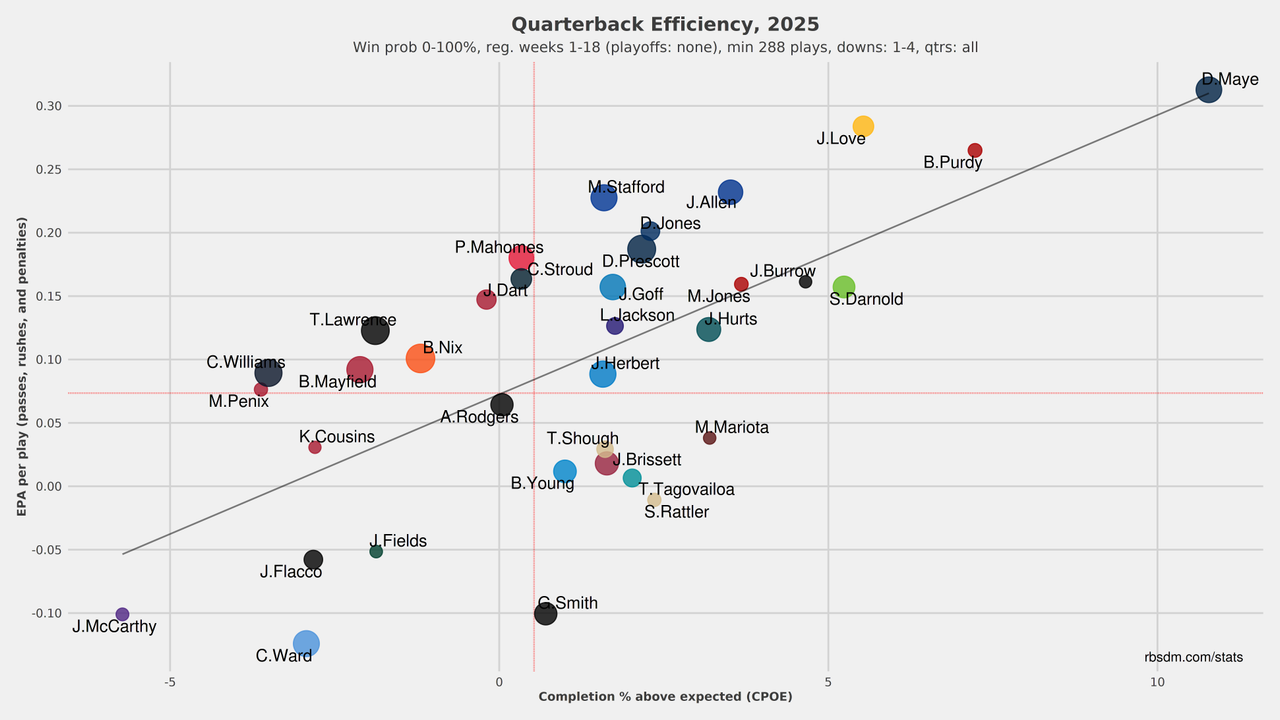
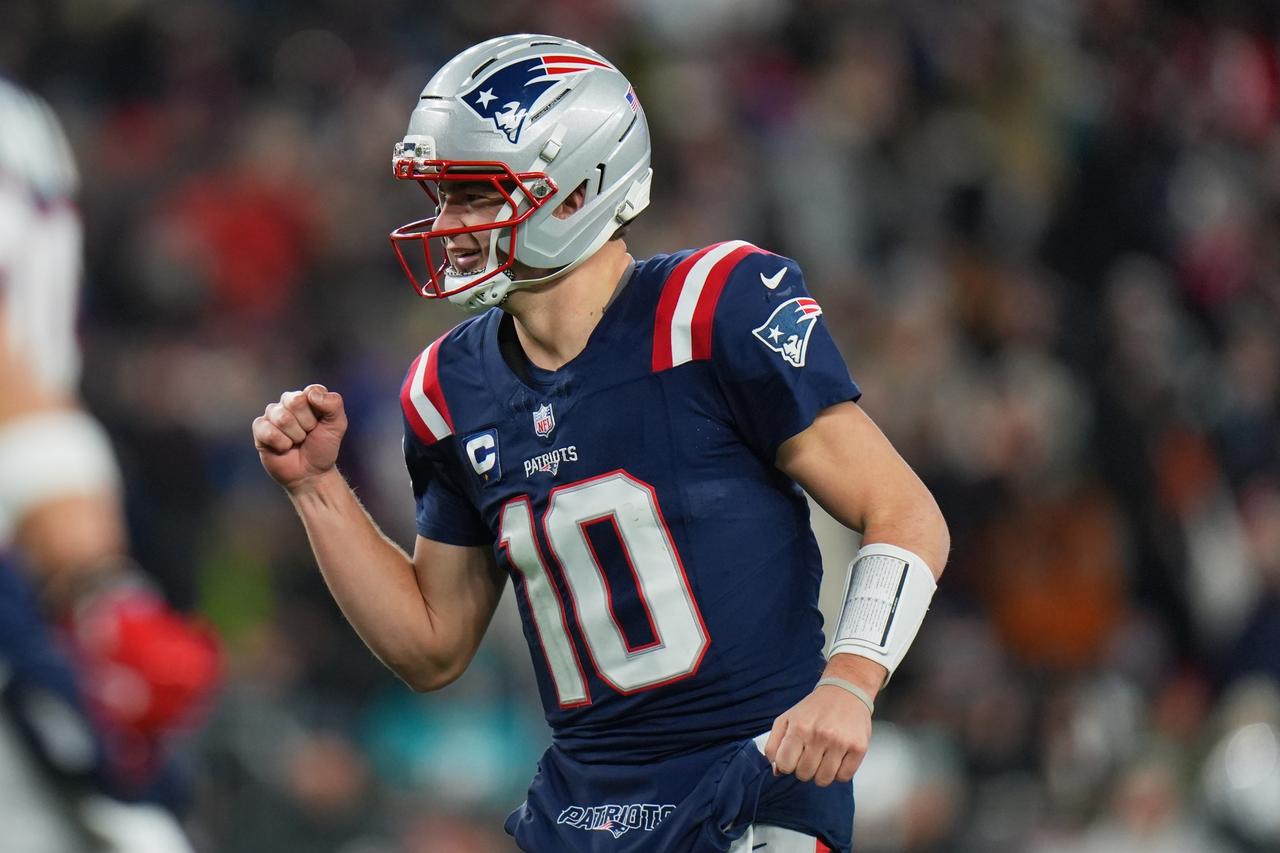
This was a close two-player race with a clear efficiency leader and clear total volume leader. To me, the differences in their supporting casts and record were the tiebreakers. Drake Maye was 1st in EPA per play (still on top-10 usage), and the Patriots' supporting cast is below average. Maye's processing took a big leap, as did his accuracy. He easily led in completion percentage over expected (+10.3) while delivering the most consistent deep ball of the year. As a side hustle, Maye was a red zone rushing weapon and an effective scrambler whenever needed. Perhaps most surprising and valuable was his ability to navigate a bad OL. When pressured, the Patriots had the 3rd-best EPA per play. That's the definition of individual value and separated him from my runner up, who was 12th in that same metric.
Matthew Stafford easily led in touchdown passes (46) and passing yards (4,707), while still ranking 4th in success rate and 5th in EPA per play to appease the fancy bois. Those scores, by the way, were the most in a season since Aaron Rodgers' 2020 when defenses were entirely structured differently. Stafford manipulated zone defenders with his eyes from within the pocket at a level I don't remember seeing before, and his arm strength is still high-end. Stafford benefited from having Sean McVay Puka Nacua, Davante Adams, a quadruple TE room, and the best rushing success rate team in decades, but he has as much freedom and say in the offense as anyone in the league. There's no way to properly defend Stafford at this point. The Rams were 1st against man coverage, 2nd against zone coverage, and 1st against the blitz.
Josh Allen doesn't have an efficiency or head-to-head case against Maye nor a total volume case against Stafford, but he still played like an MVP for most of the season. I'd also argue in unideal circumstances. The Bills wide receiver room was amongst the very worst in the NFL, and their ground game, while very good, is partially tied to his legs. Amongst playoff teams, the Bills were as reliant on super-hero plays from their QB as anyone. Allen still finished 4th in EPA per play and dragged an injured defense to a 12-5 record.
Myles Garrett is an unconventional MVP vote in the modern era, but he broke a record and did it honorably. His sacks per team pass attempt face was the best of all time, and the Browns don't have an elite counterpart to take pressure off. There weren't standout QB options beyond the top-3 this year, so let's reward true greatness.
Jordan Love was 2nd in EPA per play (+0.29) and dealt with injuries at every position around him. He didn't have Christian Watson or Jayden Reed early, then lost Tucker Kraft, then lost C Elgton Jenkins and RT Zach Tom. The OL only was 29th in pressure rate allowed per PFF, and he handled it nearly perfectly. Love got out of trouble by throwing it over the top and quietly buying time in the pocket with subtle pocket movement. He went 9-4-1 in his healthy games, providing Green Bay with the most EPA per dropback through 15 weeks when they clinched the playoffs.
2025 Offensive Player of the Year
1. Puka Nacua 2. Jaxon Smith-Njigba 3. George Pickens
To me, the definition is the best offensive player removing all QBs. They should formally make that switch, as it should be nearly impossible to win MVP as a non-QB if you're voting properly.
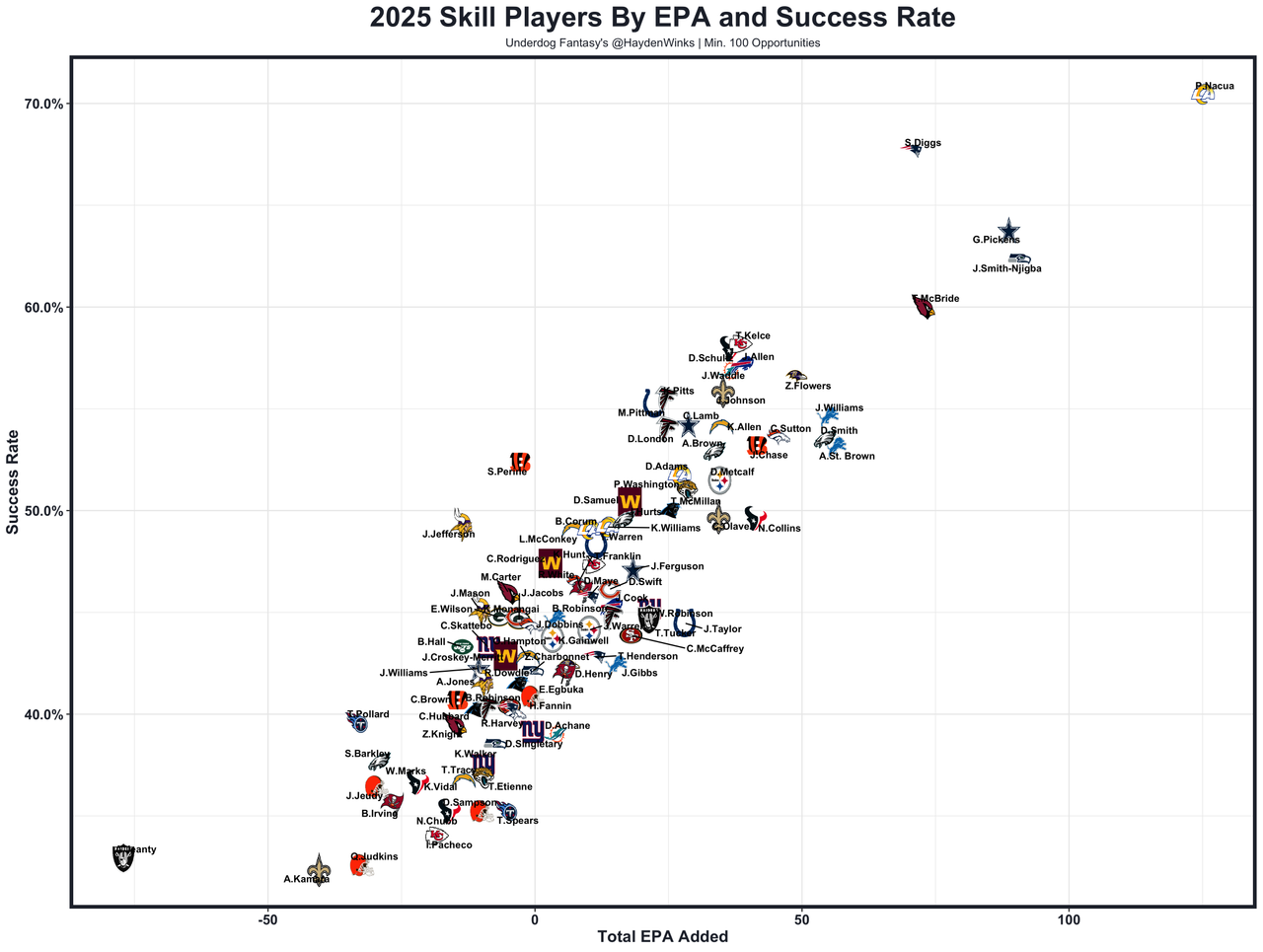
Puka Nacua easily led non-QBs in EPA added (+125.4) and success rate (70%). If not for some Davante Adams goal-line scores, that could've even been better. Adams missed a few games late, and Nacua immediately stepped up with 12-225-2, 5-57-1, and 10-76-1 receiving lines. His highlight grabs with one hand or near the sideline were the best in the NFL, and he is one of the most willing targets over the middle and blockers in the ground game as a side hustle. Nacua's 115 total yards per game puts him on all-time lists.
Jaxon Smith-Njigba was 2nd in EPA added (+90.7) and did so by adding downfield ability to his bag in a new offense. His 3.4 yards per route is one of the very best since the stat was created, too. George Pickens wasn't far behind, even if his target numbers weren't quite as high. Pickens was 3rd in EPA added (+88.7) and became infinitely more consistent with better QB play. In fact, the impending free agent was 4th in success rate (64%) among WRs with 50+ targets.
2025 Defensive Player of the Year
1. Myles Garrett 2. Micah Parsons 3. Will Anderson
Discussing the NFL all-time sack leader is a waste of time, especially when Myles Garrett was also double- or triple-teamed on 65% of his pass rushes (3rd highest).
Micah Parsons finished with 12.5 sacks in about 12.5 games if we factor in his missed time with a torn ACL and the first couple games directly after the Packers' trade. His per-play impact is only matched by Myles Garrett, and without him, the Packers could've missed the playoffs. ESPN had Parsons 2nd in pass-rush win rate, while PFF graded him with a league-high 69% double- or triple-team rate.
Will Anderson had 12.0 sacks, but his impact is better felt with the advance data. Offenses chipped him at the 3rd-highest rate (24%), and he still was 4th in ESPN's pass-rush win rate. The Texans don't do a lot to scheme him into clean looks either, so Anderson is just winning by being a dog. He's also one of the most impactful super star pass rushers as a run defender, which helped the Texans finish 1st in points allowed.
2025 Offensive Rookie of the Year
1. Tetairoa McMillan 2. Jaxson Dart 3. Tyler Shough
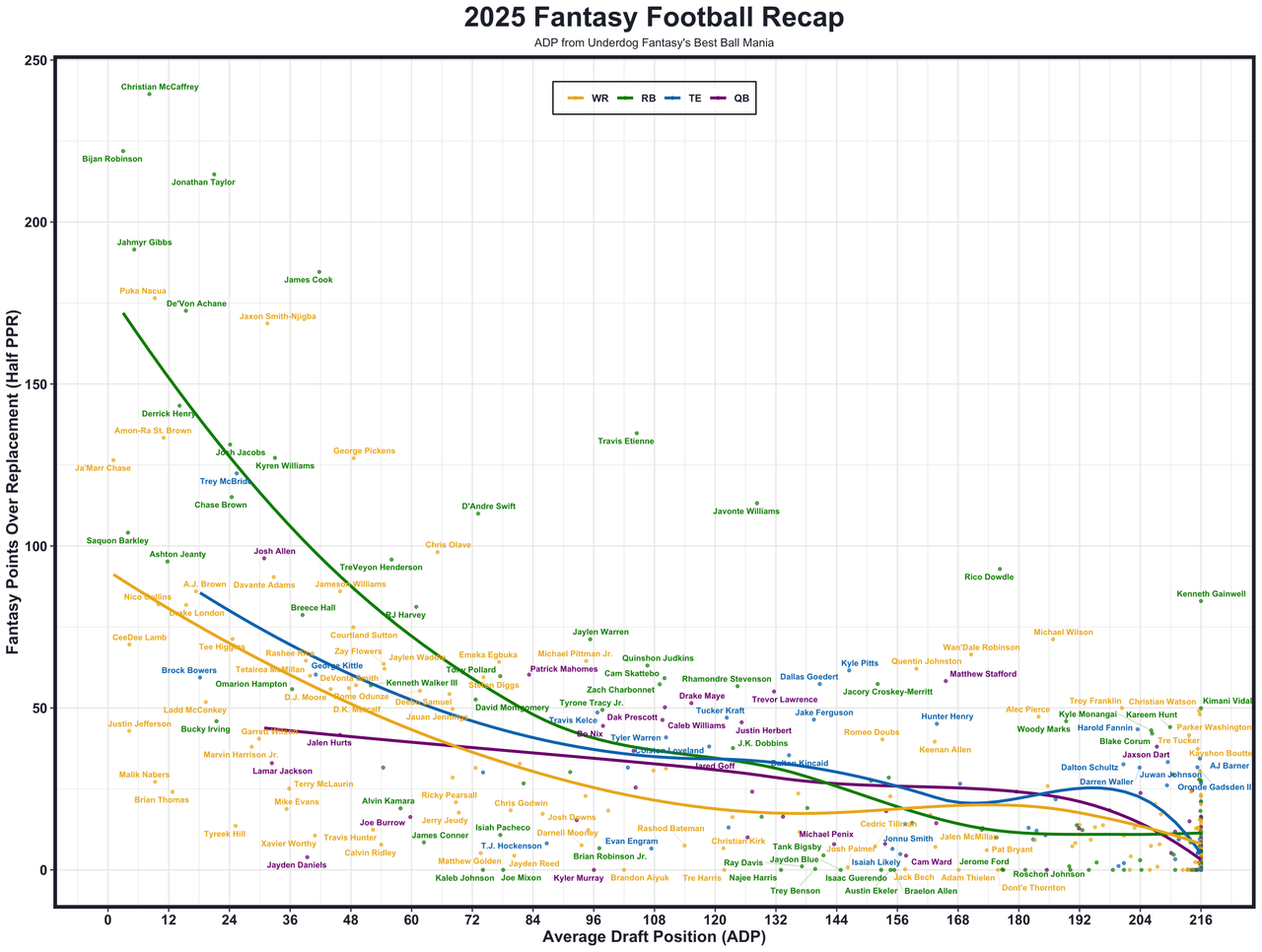
This was a very down year for the award, but Tetairoa McMillan squeaks by after eclipsing 1,000 receiving yards on a "playoff team" as the very clear best skill player on the team. McMillan was the WR20 in receiving yards per game (59.6) and the WR28 in EPA added (+25.8) despite up-and-down QB play as the X receiver. The rookie showcased enough speed to run away from DBs after the catch and threaten vertically. That was the lone question on his otherwise high-floor prospect profile. His upside is similar to Drake London's, and he will be a top-50 pick in fantasy football drafts once again.
Jaxson Dart was nearly my rookie of the year. It was truly that close, even if the Giants record hides what Dart was offering on a per-play basis. He was the QB12 in EPA per play (+0.13) behind an average OL with a underwhelming skill group, as Dart only had 13 dropbacks with Malik Nabers throughout the year. Dart has the physical traits to eventually flirt with top-10 status. He can and wants to push the ball downfield as a passer, can throw with all arm angles, and then is a quality rusher as a scrambler and rusher (when they allow it). In fact, Dart led all QBs in total rushing EPA this year, just edging out Josh Allen. Dart obviously has room to improve with his decision making (see the Brian Flores game), but finishing above Lamar Jackson, Justin Herbert, Trevor Lawrence, Baker Mayfield, and Jalen Hurts in EPA per play as a rookie is nothing short of promising. The Giants have the 5th and 37th overall picks to surround him with more.
Tyler Shough was 24th in EPA per play (+0.03) despite being a very bad OL without a lot of depth in the skill group. By the very end of the year, Shough was hooping by himself. His arm stood out within the first few games, as he can throw with velocity to the sideline and over the middle on backside digs. Shough's age legitimately played to his advantage because he made more full-field reads from within the pocket then almost any non-1st-round rookie of the decade. While he did show plenty of straight-line speed in college, it was shocking at how mobile he looked on the NFL field. He had multiple designed rushing explosives and scores in the red zone. The Saints will absolutely treat him as the clear-cut starter this offseason, and he'd easily fetch a first-half Round 1 pick if we re-drafted today.
They don't get nearly the attention, but Jets RT Armand Membou, Seahawks LG Grey Zabel, Saints LT Kelvin Banks, Cowboys RG Tyler Booker, and Patriots LT Will Campbell all looked like hits in the 1st round. Lions LG Tate Ratledge, Bears LT Ozzy Trapilo, and Texans RT Aireontae Ersery looked like eventual plus starters on Day 2, too.
2025 Defensive Rookie of the Year
1. Carson Schwesinger 2. Abdul Carter 3. James Pearce
2nd-round LB Carson Schwesinger made 156 tackles. Before his missed Week 18, that was the 5th most in the NFL. Among off-ball LBs, his 11 tackles for loss were 3rd-most, too. That was the biggest surprise. Schwesinger was strong against blockers and often shedded them to make solo tackles. What wasn't a surprise was his range in coverage. His instincts and eyes were amazing at UCLA, and that traveled to the pros, as he was the Browns' green dot leader in the huddle.
1st-round EDGE Abdul Carter started in a rotation, was suspended for drives multiple times in the middle of the year, and then really dominated in December. If this award was about who was going to be the best long term, Carter is the run-away leader. He ended up 4th in ESPN's Pass Rush Win Rate and ultimately played over 900 snaps with Kayvon Thibodeaux missing some time. Carter's spin move was nasty, and the Giants moved him inside to further copy-cat the Micah Parsons comparison. He was extremely unlucky to only have 4.0 sacks on 73 pressures and 22 QB hits, but offenses who faced him knew to get the ball out quickly or else. Carter was also a quality run defender for his size, only trailing Donovan Ezeiruaku in the draft class in tackles on runs with a negative EPA.
1st-round EDGE James Pearce Jr. racked up a draft-class high 10.5 sacks for the Falcons, who were bailed out by sending the current 13th overall pick away to trade up for the pass rusher. Pearce has great explosion and hustle, making him an excellent choice for outside speed rushes and inside stunts. He simply glides on film and then has plenty of pound-for-pound strength on the occasional bull rush. The Falcons were smart to know where his strengths were and knew to pull him where he couldn't hold up; the run. Pearce only had 6 tackles on runs with negative EPA (compared to Carter's 17), and he was often subbed out on 1st-and-10s when teams could run at him. If he's this effective as a pass rusher each year, who really cares? Pearce is definitely good.
By the way, Eagles 1st-round LB Jihaad Campbell absolutely deserves a shoutout here after some of the crazy plays he made in coverage. Same with Bucs CB Jacob Parrish, Chiefs CB Nohl Williams, EDGE Donovan Ezeiruaku, EDGE Nic Scourton, EDGE Jalon Walker, EDGE Josaiah Stewart, DT Derrick Harmon, DT Kenneth Grant, and DT Mason Graham. It's a good defensive class.
2025 Protector of the Year
1. Garett Bolles 2. Trent Williams 3. Penei Sewell
If you haven't heard former (or current) interior offensive linemen talk about what it takes to play offensive tackle, it's worth trying to find clips. Centers can't believe what guards can do, and guards can't believe what tackles can do. To me, that makes "Protector of the Year" largely an OT award with an emphasis on the pass game as they "protect" the QB if you will.
Garrett Bolles is the leader of the No. 1 seed Broncos, protects Bo Nix's blindside, and is so rarely out of position. He wasn't credited with a single sack allowed this year, though the Broncos will protect their line with screens and boots off of play action. That said, Bolles is an absolute monster out in space because of his athleticism. He can bend, change direction, and close space with remarkable speed for the position. Ditto for the run game. When tasked with holding his spot in the normal dropback game, Bolles showed a lot of fight and recovery quickness, too. On top of that, Bolles played the most snaps amongst left tackles, something the other top left tackles in consideration can't say with Trent Williams, Laremy Tunsil, Andrew Thomas, and Tristan Wirfs all missing time.
It was a slight step down from Hall of Fame play, but Trent Williams turned out another great season in both phases. He was top-20 in Pass Rush Win Rate and 7th in Run Block Win Rate per ESPN's tracking, and the 49ers run behind him in ways most OTs can only dream about. Williams is the 49ers' enforcer in every way, and only the true elite pass rushers have the athleticism to move by him right now. A couple injuries and a tough outing with Myles Garrett break ties away from him winning an award that could be named after him.
It's a close battle between Penei Sewell and Darnell Wright for most hilarious run-block destroyers on the right side. Sewell gets the nod for being slightly more intimidating out in space, but this is the same profile. They have the power to throw guys out the club and hunt back seven players whenever they're pulled or have nobody in front of them on zone runs. They can be beaten by speedy pass rushers, like Micah Parsons, in the pass game, but that's why they are right tackles.
Others in consideration for me are Commanders LT Laremy Tunsil, Giants LT Andrew Thomas, Bucs LT Tristan Wirfs, Rams LT Alaric Jackson, Colts OG Quenton Nelson, Bears OG Joe Thuney, Titans OG Peter Skoronski, Broncos OG Quinn Meinerz, and Dolphins C Aaron Brewer.
2025 Comeback Player of the Year
1. Aidan Hutchinson 2. Christian McCaffrey 3. Philip Rivers
First off, this reward deserves nearly zero seriousness. It's also an award that really should be split into two. There's a return from injury component, and then there's a breakout candidate component. It's hard to weigh one versus the other, and it'd be better if there was one of each.
The best blend of seriousness of injury and on-field impact was Aidan Hutchinson, who broke his damn leg in half last year. For a pass rusher who relies on power and bending corners, it was not a given that he'd return to the level he did in 2025. He racked up the most total pressures on the 4th-highest pressure rate according to PFF, leading to 14.5 sacks and the 3rd-most QB hits. Hutchinson was also chipped at the 4th-highest rate, too. Equally impressive to his production was his availability and workload. Hutchinson was the only edge rusher to reach 1,000 snaps this year.
A close second was Christian McCaffrey, who checked very similar boxes. He had a career-high 413 touches, leading to another 2,000-yard season. McCaffrey was the only Niner to stay healthy the entire year, and his route running was weaponized as the other receivers missed time. As usual, he danced around bad run blocking, too. The only things to nitpick versus Hutchinson is positional value and the seriousness of injury, as CMC didn't have surgery or miss the early offseason while in rehab. He was too busy winning all of us fantasy football championships instead.
Because it's an arbitrary award, the Philip Rivers experience was so wild to me that it deserves some recognition, just like Damar Hamlin deserved recognition after his experience (and he's received comeback votes in 3 separate seasons since his injury). Rivers hadn't played in 4.75 seasons and was a 44-year-old grandpa fresh off the couch. Given the stakes, the Colts were serious about this, and Rivers held his own. If he would've won a game, played the rest of the year, or by some miracle made the playoffs, Rivers absolutely would've been my 1st-place vote.
Others in consideration are Cowboys QB Dak Prescott, Steelers RT Troy Fautanu, Saints WR Chris Olave, Patriots WR Stefon Diggs, WR Christian Watson, and Giants LT Andrew Thomas.
2025 Coach of the Year
1. Mike MacDonald 2. Kyle Shanahan 3. Ben Johnson
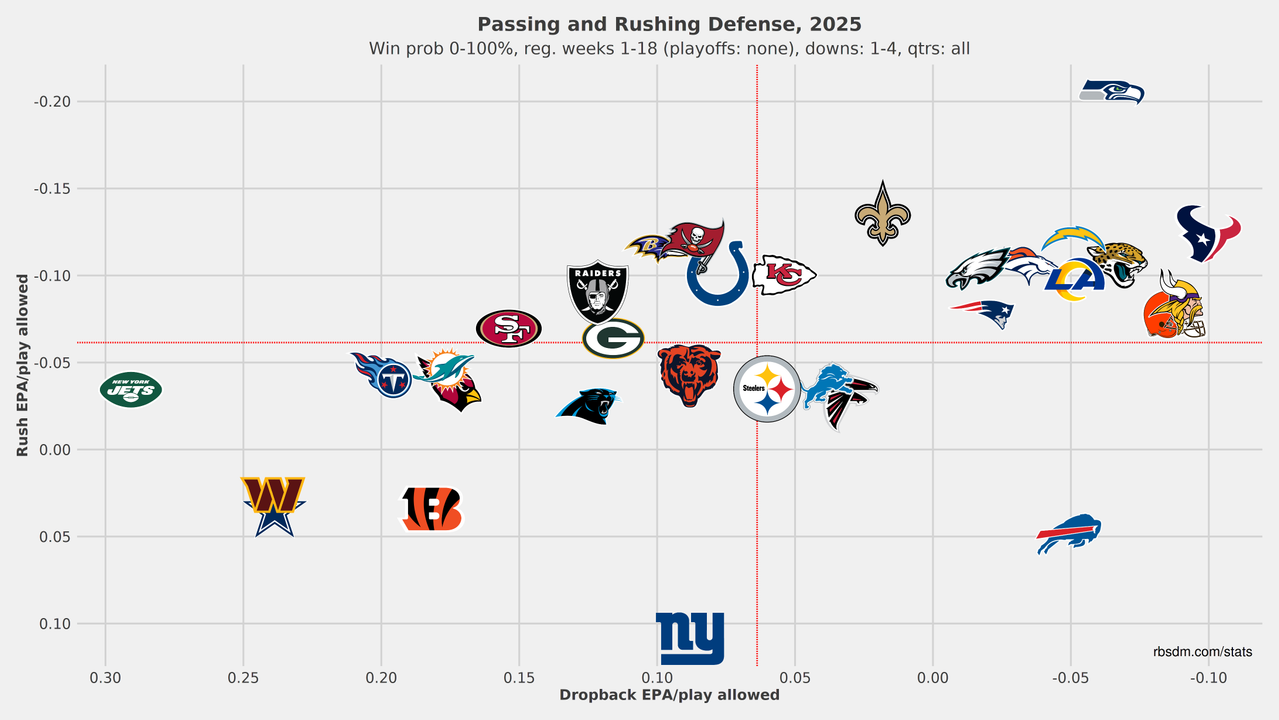
The Seahawks only had a preseason team total of 8.5 wins. They finished with 14, in a loaded division, in a loaded conference. Mike MacDonald had three difficult decisions to make in the offseason, nailing all of them by hiring OC Klint Kubiak, upgrading with QB Sam Darnold, and trading away DK Metcalf. He deserves credit for some of that. More importantly, the Seahawks have a great culture in the building and their defense is arguably the best. MacDonald is the best defensive designer in football right now, as he minors in just about everything without a clear major in everything. His versatility makes him able to handle the Shanahan tree and the spread offenses. As a tie breaker, MacDonald's special teams was amongst the best in the NFL. Everything about the Seahawks is very professional right now.
If the 49ers win Week 18, they would've had the No. 1 seed and Kyle Shanahan walks away with the award, one he should be amongst the finalist for every single year. The Niners went 5-3 with Mac Jones, then 7-2 with Brock Purdy who he's developed into a real top-12 QB. His OL has Trent Williams and not a lot else, yet the ball moved at will without Brandon Aiyuk, Ricky Pearsall, and/or George Kittle. No excuses. Just finishing 3rd in offensive success rate. The 49ers being in the hunt for the top seed while the defense collapsed due to injury is another feather in Shanny's cap.
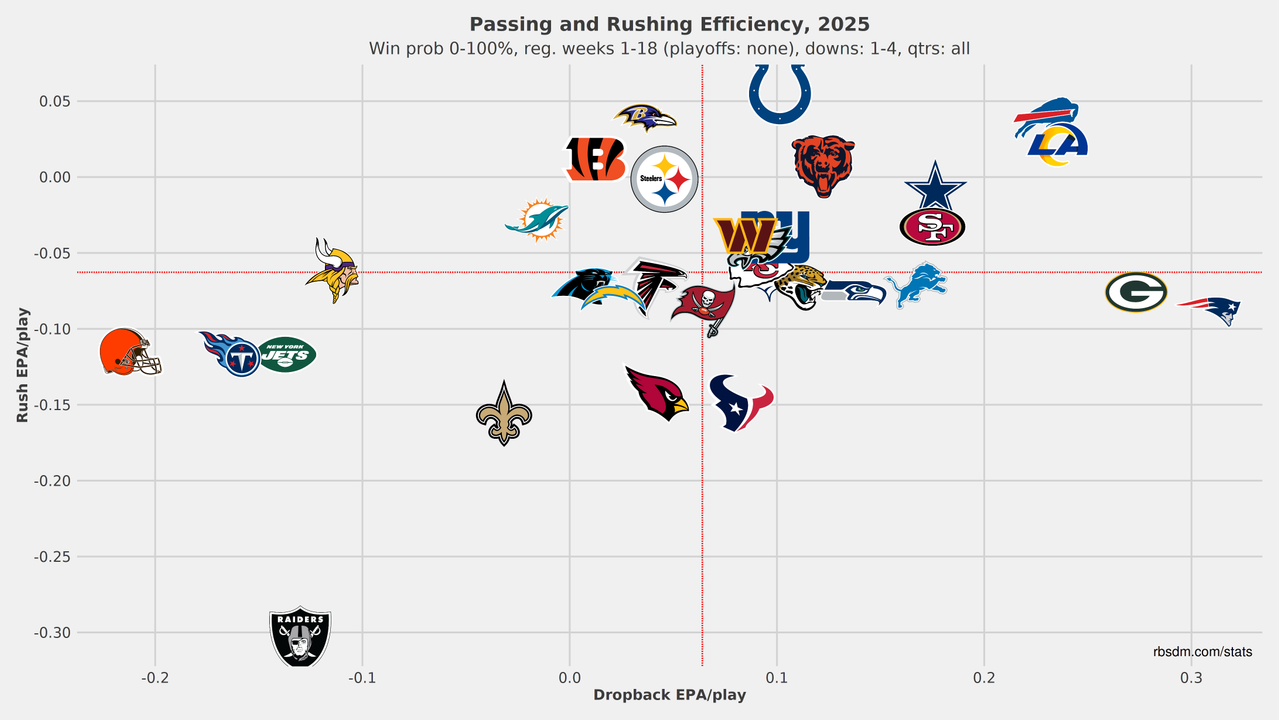
The Bears were 26th in EPA per play last year, added Ben Johnson (and a new OL and multiple skill guys), then finished 8th in EPA per play in 2025. That's coaching. Chicago created an identity with outside zone runs, especially after an early-season bye, and the Caleb Williams began settling in as he had more time to learn under Johnson. Perhaps most overlooked is how good the OL turned out despite having zero chemistry together. ESPN's Block Win Rate graded them 1st on pass plays and 6th on run plays. There's a lot of communication required to pull that off. Ultimately, the Bears won a division that entirely finished above .500, and the defense was only 20th in EPA per play.
Others in consideration were Liam Coen, Sean McVay, and Mike Vrabel.
2025 Assistant Coach of the Year
1. Josh McDaniels 2. Brian Flores 3. Jesse Minter
The Patriots went from 27th to 1st in EPA per play in one year, with the same QB. Coach Mike Vrabel deserves plenty of credit for seeing the vision and making the hire, but OC Josh McDaniels was the leader and play caller of the offense. He got the most of rotations at WR, TE, and RB by only using each player to their strengths, and then he navigated an on-paper bottom-5 OL with great design. The Patriots leaned into their pass-game strengths at the end of the year, and McDaniels did a bit of everything in both phases. This all after taking a year off. Well done.
The most exciting defense every year is whichever one Brian Flores is coaching. Yet again, Flo dialed up the most blitzes. This year, it was by a magnitude of 175 more than the defense in 2nd. It sounds like a dangerous strategy, but the Vikings used smart safeties to navigate things in the secondary and often stayed in two-high coverages despite bringing an extra rusher. The complexity is a death sentence for any rookie QB or play caller, and that makes him a massive asset for the Vikings, who were 4th in EPA per play allowed. They do so without having any All Pro talent.
The Chargers aren't nearly as exciting on defense, but DC Jesse Minter is as sound and complex with his zone coverages as you'll see. Los Angeles was 2nd-lowest in their man coverage rate, rather living in the two-high zone world. In it, the Chargers had the best PFF coverage grade, allowing roaming back-seven players like Derwin James to use their instincts to their maximum. They ultimately finished 5th in EPA per play allowed even with EDGE Khalil Mack having an IR stint and after losing EDGE Joey Bosa and DT Poona Ford this offseason. All of the play callers ahead of him on defense have been head coaches before. Minter is likely next.