2026 NFL Draft EDGE Rankings
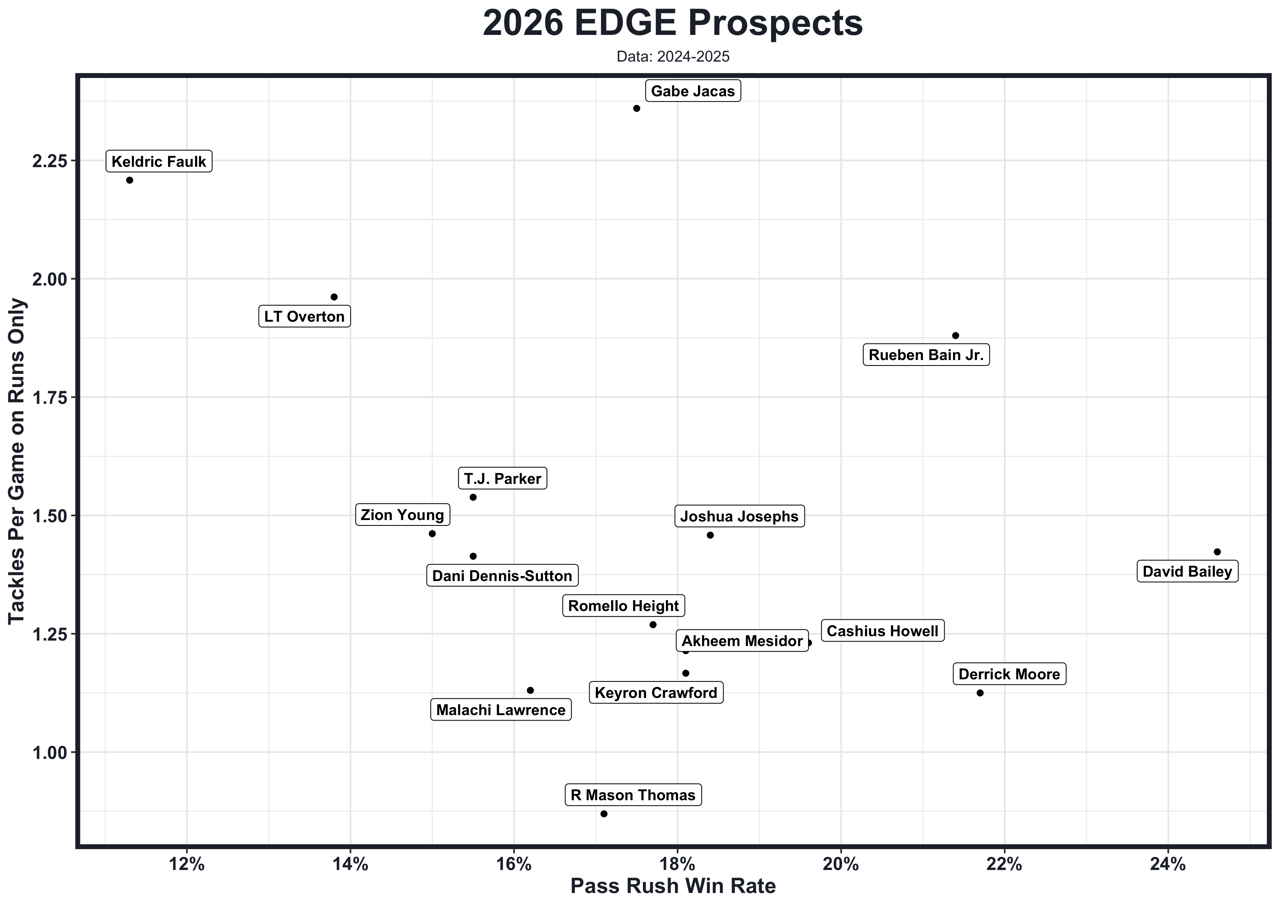
The 2026 NFL Draft EDGE class is really deep, even if there are clear weaknesses from each player. This could be a class full of quality rotational players, but there will be valuable players picked on Day 2. The things I'm looking for are in this order:
Get off: ability to threaten the high side with athleticism.
Effort: chase down, fighting through doubles, setting the edge.
Strength: required for run defense, and collapsing the pocket is valuable.
Bend: turn at the top of the arc or be able to move laterally on inside moves.
Counter moves: can be a bull rush or real inside counter.
Awareness: locating the QB and understanding rushing schemes.
Hand usage: something that can get developed but valuable when good.
We'll have full rankings over on YouTube, but follow us on socials to find bonus film breakdowns on these prospects, too. We'll also have NFL Draft props in the Underdog Fantasy lobby soon. You can sign up here with a bonus:
Rueben Bain Jr., Miami (Grade: Early Round 1)
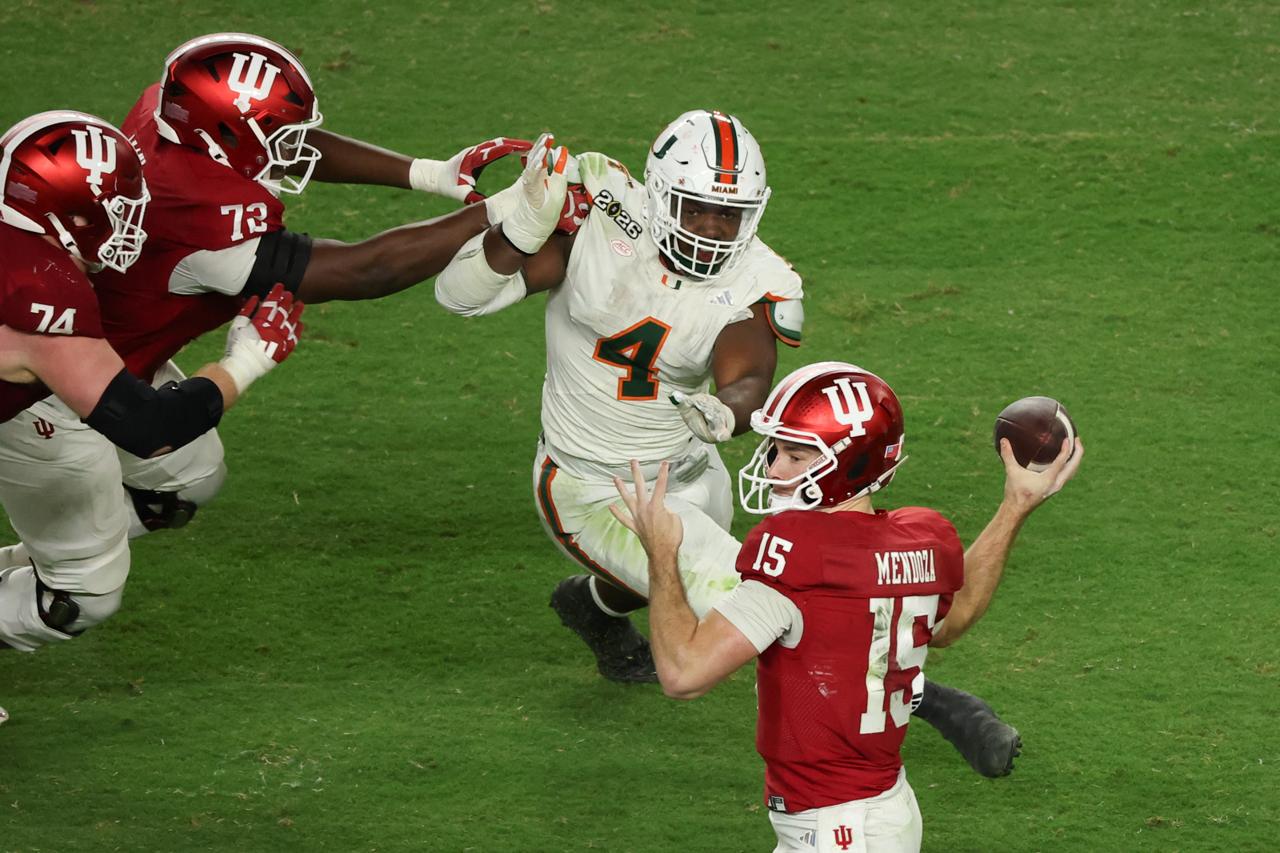
The 21-year-old early declare is a dumb thiccc edge rusher at 6'2"/263 who was mostly a high-side rusher from an off-tackle four-point stance. The former 4-star can be moved around the front and kicked inside on some passing downs. His adjusted production sits in the 85th percentile among drafted EDGEs since 2005, and this past year, Bain easily led Power 4 edge rushers with 75 QB hurries (the next closest was down at 51!!!), while posting the 2nd-best win rate (24%). He did so next to another potential 1st-round pick against a difficult schedule.
To the surprise of many tackles, Bain has more bend than most of his size. He turns the corner and uses his extremely strong core and legs to stay on his path to the quarterback. That led to an absurd 38% win rate on outside moves, despite having bottom 1st percentile arm length (31"). He doesn't have a pass-rush plan reliant on long arms. He has a consistent, nice first step and threatens OTs with power or with hand usage to open up the outside shoulder. Bain most-often wins with a cross chop, ghost, rip, or swipe, none of which require long arms. He also does a good job of not being squared with OTs to expose his reach disadvantage. At the top of the arc, Bain has real bend, is too powerful to knock off his spot, and is often keeping low pad level to maintain leverage. It's what separates him. Bain only used a bull rush on 6% of his reps, and those are often after initially setting up an outside move first. There are wins where his power comes into play, but he's not bull-rush reliant.
His inside counter moves are mostly a huge club (like a boxer throwing a right hook) or a swim move with a little euro step action, once again neither of which are long-arm reliant. His other inside moves aren't polished or explosive, which is why so many of his reps end up in a brawl. Essentially, he's far more likely to finish with effort than be hitting a spin move. There were other times where his awareness of where the QB was resetting to allowed him to create pressure late into the dropback. All in all, Bain can have 10+ sack seasons with this profile, even if he's not going to lead the league in sacks.
Bain is physical enough and plays with enough leverage to play on run downs, even if his short arms will create some issues. He may not finish some plays or set the edge to the same degree that a longer defender would, but Bain did eat up snaps at Miami and finished with 15.5 TFLs. His energy, physicality, and leadership make him a great teammate. Comp: Normal-Biceped James Harrison, Melvin Ingram.
David Bailey, Texas Tech (Early Round 1)
The 22-year-old senior is a 6'3.5"/251 dynamic, straight-line speed rusher who had 3 quality years at Stanford before a true breakout campaign at Texas Tech. Bailey had 19.5 tackles for loss, 14.5 sacks, and led Power 4 edge rushers with a 24% pressure rate and 25 QB hits. Most of that was off the edge from a two-point stance after threatening the high side with juice. At the NFL Combine, he had a 93rd percentile weight-adjusted forty time, a 96th percentile broad jump, and a 67th percentile vertical.
His get off speed stands out instantly on tape. It's not just good. It's closer to rare. Bailey immediately puts pressure on the high side, to the point that he didn't have to use his hands that often to create pressure. His go to high-side move was in the dip/rip department with the occasional ghost move. His shorter frame allows him to get under tackles' arms, which is once again, all set up being so quick out of his stance. There aren't many hand-usage based wins right now. That was fine against lower-level competition, but his forgettable 13.7% pressure rate against Utah, Arizona State, and Oregon is notable and did show some of the areas needed for improvement. Perhaps the other weakness as an edge rusher is his lack of side-to-side agility, which more shows up in his streamlined counter moves.
Bailey has a deadly counter move: the spin. There were at least 10 pressures on them alone, and that move is so overwhelming that it helps him on the high side still. It won't be quite as lethal against faster OTs, but his ability to burst after that spin is sensational. Just ask 1st-round RT Spencer Fano. His other counter is transitioning speed-to-power with a bull rush. He's pound-for-pound strong and with OTs so concerned with his speed, Bailey can occasionally win with surprise knockback power. There aren't long-arm or forklift wins in this style (67th percentile arm length), but it's another great move on pure passing downs. Lastly, Bailey will pick up sacks with wild chase down speed late into the dropback. If he's chipped by a TE, he can use the open space and pass-rush delay to fly to the quarterback exiting the pocket. The floor as a pass rusher is very high, as is the upside.
Bailey will not be as effective against the run. He's just in the bottom 22nd percentile in weight, and there isn't a lot of weight in his lower legs. Fano was able to drive him a few times in their 1-on-1 reps, and he's not a power-based tackle. Bailey is so explosive that he will be able to shoot gaps or chase down backs on perimeter runs, but his 3.7 tackles per game puts him below average among drafted EDGEs. He doesn't have knockback power to set the edge, so it's entirely possible he is subbed out on early downs for bigger bodies. Ultimately, Bailey is an fantastic pure speed rusher with very clear weak spots that defenses will have to build around. His burst is too tantalizing to over think, but he is not a blue chip talent throughout. ... Upside comp: Nik Bonitto.
Akheem Mesidor, Miami (Late Round 1)
The 6th-year player is going to be a 25-year-old rookie, but there's context here. The former 3-star recruit came in as a 195-pound OLB from Canada and has developed into a good athlete with size (6'3"/259 with 32.2" arms) and a motor. He posted a fantastic 21% win rate on all pass rushes with 12.5 sacks and 17.5 TFLs, while lining up at a variety of spots. Mesidor is mostly line up off-tackle from a three-point stance, but his rushes up the B-gap were encouraging as he may move inside on obvious passing downs in the NFL. This all assumes that the rumors about his foot injury coming out of the NFL Combine aren't too bad to play.
Mesidor has great hand usage, violence, and pass-rushing repertoire. His first step is well-timed and explosive, and he keeps the opposition on their toes by changing his pacing as a rusher with more stutters, hesitations, and quick angles than many of his size. He does not use the same move over and over again, though his ghosts, dips, and rips were his top-performing moves. He doesn't have exceptional bend at the top of the arc, but it's good enough to be an NFL starter. When he's fully stopped and has to re-accelerate is when his athleticism looks better. Where he closes the gap is in his effort, power, and awareness. He creates a lot of production by staying engaged well after the initial plan, and he can anticipate where the QB is resetting to. None of that is a surprise if you've listened to Mesidor's awesome interviews. Some of those finishes from the college game will be harder to replicate because his average length and athleticism could get him swallowed up by NFL OTs.
His primary counter moves are a swim move and a bull rush pointed to the inside shoulder. His lateral ability to set up a swim move is wicked for his size and that trait could make him a candidate to pick-up work as an interior rusher or stunter. He can generate speed to power and has the ability to contort his body to win on the inside shoulder, even if he's not long-arming linemen. That said, Mesidor only went with a strict bull rush 3% of the time per PFF.
The run defense will come with highs and lows. His aggressive style and get off will create some highlights and led to 17.5 TFLs and 4 forced fumbles. He plays with good leverage and awareness, so he'll be reliable in the run fit, especially if the DC is encouraging shooting gaps on occasion. He is not going to set the edge with ideal length, but the effort and general power are there. He is not overly dynamic in the chase down department and missed plenty of near tackles, something I don't think is correctable given his age and measurables. In general, Mesidor is a ready-made above-average starter if his medicals are cleared by doctors.
EDGE4 Malachi Lawrence, UCF (Late Round 1)
The senior is a 6'4"/253 edge rusher with 33.6-inch arms who lit up the NFL Combine with 92nd percentile weight-adjusted forty and 96th percentile jumps. The straight-line explosiveness is undeniable. He's an off-tackle speed rusher who rotates between two- and three-point stances with an excellent 20.2% win rate, though it came against poor competition. He did light up the Shrine Bowl practices per reports, but then wasn't invited to the Senior Bowl for some really odd reason (or maybe he declined).
Lawrence fires off the ball with enough speed to win the outside edge against a vertical set and has a true variety of outside moves from a cross chop to a swipe to a ghost. He throws his hands with violence on top of having great length. At the top of the arc, Lawrence can bend for a well-built edge. He then chases QBs outside the pocket with fantastic closing speed and reach. All of these skills translate to the pros, and his athleticism matches what the top-10 players at the position have. His inside counter moves are a little telegraphed right now, but Lawrence has the fluidity to improve. He's developing a spin move as a go-to counter, while this little swim move is more proven already. If he can add two go-to counters on top of threatening the high side, he'll hit a high ceiling.
The run game is more unproven with a bottom 5th percentile tackles per game mark. He nearly made a bunch of tackles but could get a little lost out there, and he's only going to play run downs from the edge. That said, he does have the arms and athleticism to develop, and he made some sweet plays on perimeter runs by beating OTs to the spot while showing a willingness to hammer a lead blocker. Lawrence is a high-upside pick whose primary weakness is the strength of schedule.
Cashius Howell, Texas A&M (Early Round 2)
The redshirt senior is a maxed-out 6'2"/253 pure outside linebacker edge rusher who spent 3 years at Bowling Green before 2 at Texas A&M, where he won SEC Defensive Player of the Year. He posted a very good 20% win rate on all pass rushes with a 24% pressure rate on outside moves. His 14 TFLs and 11.5 sacks were career numbers last year, mostly off the tackle from a two-point stance. Howell has quality athleticism, including an 83rd percentile forty time with nice on-tape agility, but he has bottom 1st percentile arms (30.5") and 35th percentile jumps despite being undersized. He'd be an outlier if he pans out.
Howell has a good first-step burst (when he's playing on time), and his ankle flexion around the corner stands out immediately. He can really bend, and when he takes off to chase down a QB, his speed also stands out. Howell doesn't always win with elite get off as a high side rusher, but he makes up for it with a great pass-rush plan. He won with a little cross chop, dip-and-rip, or ghost move when working the high side of a tackle. His ability to literally dip under a tackle is unique. He also occasionally won with surprising pound-for-pound power and leverage. He had a couple forklift wins and bull rushes, even if it's clearly a change up that won't be nearly as effective with his short arms against NFL talent. This all assumes he gets off the ball on time, which was an odd but notable problem for him.
His counter moves were well rounded, too. He can jump laterally while swimming or euroing, then also flashed a couple spin moves, too. He should be an effective looper and stunter to use his bend and chase down speed, which is becoming more common in the modern NFL. Howell will need to drop into coverage at this size on occasion, but he should be able to handle that when he is subbed in on pure passing downs. He also deflected 6 and 7 passes in recent years, a very strong number.
Howell doesn't have much of a chance as a run defender given his 2nd-lowest wingspan since the 1990s, per Mockdraftable's database. He only had 5th percentile tackles per game among drafted EDGEs since 2005, so his entire profile comes down to his pass rush rotation ability. He looks like a No. 2 edge rusher on passing downs from an off tackle two-point stance. Comps: Yannick Ngakoue, Chop Robinson, K'Lavon Chaisson, Nick Herbig.
Jaishawn Barham, Michigan (Early Round 2)
The former 4-star recruit is a 22-year-old converted LB to EDGE with 2 years at Maryland and 2 years at Michigan. At 6'3.5"/240, he played off-ball linebacker, lined up off the edge, and walked up into the A-gap. He's versatile in ways the modern NFL is leaning into. As a linebacker, he can blitz, spy, rush the a gap from a two-point stance, drop from a mugged up look, or just play a normal off-ball assignment. As an edge rusher, he can rush the high side, be unlocked on loops/stunts, and even set the edge on conflict downs. Barham has good on-field athleticism, and tested well at the NFL Combine with a 78th percentile broad jump, 74th percentile forty, and 68th percentile 10-yard split (among drafted EDGE rushers).
Barham is a total mad man in all phases with a nice first step. He can threaten the high side with burst, then has really violent hands before having the ability to turn the corner. Barham is still learning the timing and general pass rush plan because he's so new to the position, but he has the traits of a speed-rushing starter. He can knife inside, which really stood out when lined up inside. He only has 12.0 career sacks because of his hybrid profile, but there's enough juice and violence to get him on the field immediately. It would not be a surprise if took a few years before really paying dividends, however.
Against the run, Barham holds his own as an edge rusher. He is just so down to take on pullers and strikes with enough violence to set an edge. His lack of weight will hold him back as a full-time edge rusher, but Barham will likely be moved around the formation to play to his strengths, rather than have him sit opposite a double team on a pure rushing down. There are some overly spicy moments, like when he head-butted a referee, but sometimes that's what a defense needs. Comps: Andrew Van Ginkel, less athletic Jalon Walker, Leo Chenal.
T.J. Parker, Clemson (Early Round 2)
The 21-year-old early declare is a former 4-star recruit (43rd overall at 247) with at least 5.0 sacks and 9.5 TFLs in all 3 of his collegiate seasons. He did have an 11.0-sack year, too, but his 15.7% win rate over the past two years is fine, not great. Most of his college snaps came as an outside linebacker from a two-point stance. Development needs to happen for Parker to turn into an effective pass rusher at the next level, and Parker has the frame (6'4"/263) and arms (33") to have some hope long term. Unfortunately, his athleticism does not stand out, whether that's with first-step get off, turning the corner, or having loose hips in the counter rush. His weight-adjusted 40 time was his best NFL Combine metric (70th percentile), but he had 56th percentile jumps and ducked the agilities.
His pass-rush plan right now is largely one-fold: the long arm. He can generate some power and use above-average arms to collapse the pocket. That doesn't always lead to a sack himself, but it's a translatable skillset if he can at least threaten NFL tackles with other moves. He'll use a cross chop and swipe to get to the outside shoulder, but the hit rate of them isn't high and he doesn't have much bend at the top of the arc. He plays a bit too upright to be a difference maker. His inside counter moves are almost non-existent right now, and his tightness in the hips is felt here. This could limit his upside in the stunt department, though his length and power could help out his teammates as a crasher. Parker simply needs years of training to figure out what his go-to speed and counter move should be.
Parker should be effective against the run, however. He has the frame to set the edge and make tackles away from his gap on occasion. His 78th percentile TFLs per game among drafted EDGEs provides him with a floor while he develops his pass-rush plan. Getting to the right coaching staff will be key for how far away he is as a pass rusher. In the interim, power and length are carrying a lot of weight for the 21-year-old.
R Mason Thomas, Oklahoma (Round 2)
The former 4-star recruit spent all 4 years at Oklahoma and won't turn 22 until Labor Day. At 6'2"/241, his size is far from ideal (6th percentile weight with 4th percentile arms), but he does play hard to overcome it. He peaked at 9.0 sacks in 2024 with a solid 17.3% pressure rate, and he did so from a variety of alignments. Thomas can rush from two-, three-, and four-point stances, with his best stuff coming from off the tackle (though he did play squared up too). Thomas has more burst than this on tape, but he had a 68th percentile forty time and 55th percentile 10-yard split at the NFL Combine and ducked the rest of the tests.
Thomas has great get off at the snap. He explodes and threatens the high side on every rep with pure speed. He does not the wide variety of pass-rush moves, rather winning by turning the corner at a high rate of speed. He beat 1st-round LT Kadyn Proctor just that way. Thomas did use the cross chop, swipe, and ghost moves on some of his wins at least, but his best stuff was just having the ability to turn the corner after beating a vertical set to the top. There are also chase down plays based on his speed and effort, but there are other times where his lack of length hurts his ability to finish. That gets harder in the NFL. Thomas' wins will be speed-based, but that looks like a very translatable skill set here.
Thomas did have plenty of inside counter moves because tackles have to set so vertically. He can knife inside with a quick club-rip and (very) occasionally will convert speed to power with a bull rush or forklift (see vs. Auburn RT). He has a little euro step, too. Where he will absolutely be effective in the modern era is as a looper/stunter. His speed and bend are ideal for just that, and the best coordinators are using that rather than blitzing to create communication errors by the OL.
Against the run, his effect is very minimal. His tackles are chase-down types rather than stack-and-shed wins, which is a direct reflection of his size limitations. Thomas only had 1.8 tackles per game, putting him in the bottom 1st percentile among drafted EDGEs since 2005. Yikes. He's simply a rotational pass rusher with juice. That's still a very valuable role when it hits, and he does a lot of things right in that specific role. As a fun fact, his mother named him "R Mason" because his family had a history of "R" names, but she didn't find a name that started with "R" that she liked. Amazing.
Keyron Crawford, Auburn (Round 2)
The 22-year-old is a former 3-star recruit who spent 2 seasons at Arkansas State before 2 at Auburn, lining up off tackle mostly from a two-point stance. He started football late, so there's more development potential than most. At 6'4"/253 with 32-inch arms, he looks the part, and he's reportedly loved by his teammates and staff. His 19.6% win rate is well above average, but his 5.0 sacks are just average. He did not test at the NFL Combine.
Crawford has a good first step and active hands when rushing the high side. He has a plan in place and landed swipes, cross chops, rips, and swims to get around tackles with nice bend at the top of the arc. Many of his finishes are based on a lot of grit and effort, which is a good sign. The counters aren't there yet, though. He landed a spin move and did get the inside shoulder some, but there's not a big diversity of threat. He did bull rush the Oklahoma tackle for a QB hit, but that was an outlier rep rather than a consistent threat. To his credit, Crawford chases QBs all the way to the sideline, will battle through double teams eventually, and seems prepared pre-snap. To hit a pass-rush ceiling, he absolutely needs to improve his counters, because NFL OTs will set against his speed rushes and control him without anything else.
Crawford does not stand out as a run defender. He only had 18th percentile tackles per game and does not have the monster build of a standout edge setter. He does fight and have pound-for-pound strength, so he should be able to survive on some conflict downs. He profiles as a No. 2 or No. 3 edge rusher who has a little more developmental upside than that.
Romello Height, Texas Tech (Round 2)
The 25-year-old had 4 stops in college (Auburn, USC, Georgia Tech, and Texas Tech), which is never a good sign! Height only had 6.5 sacks in his first 5 college seasons before breaking out opposite David Bailey as a super senior (10.0 sacks on an elite 22.3% win rate). He did so purely out of a two-point stance off the tackle as a speed-only rusher. Height does have NFL athleticism (90th percentile jumps and 74th percentile forty time), but he is extremely light at 6'3"/239 for a 25-year-old. That immediately puts a hard ceiling on what his role and upside can be.
That said, his first step is springy, so Height can threaten the outside shoulder and set up inside counters off them. His hand usage was strong, as he pulled off many cross chops, swipes, dip/rips, etc. for pressures. His interesting move is initially angling inside and then planting back to the outside shoulder. He parlayed that into a nasty spin move to the outside shoulder once. He's a really athletic mover in general, even if it comes with too much chaos. Height has some of the best inside counters in the class. He had many wins on spin moves, inside swipes, and then was unleashed on stunts against slower-footed guards. His sideways bounce really stands out, as it should for a 239-pounder. It could be so good that he is a legitimate pass-rushing threat, even if he's only going to play pure passing downs.
It's hard to see Height playing many rushing downs as 239 pounds. He only had 12th percentile tackles per game among drafted EDGEs. That leaves Height as a rotational No. 3 edge rusher who could end up with 5.0-8.0 sacks in the NFL despite playing part-time snaps. That's a valuable player if his background checks out.
Zion Young, Missouri (Round 2)
The 22-year-old senior is a 6'6"/262 edge rusher and former 3-star recruit who spent two years at Michigan State before two years at Missouri. He moved around the defensive line some, but he was mostly lining up off-tackle in a three-point stance and will play there in the NFL. Young is a raw prospect with real size and length (33" arms). His 18.4% pressure rate is solid and when adjusting his entire production profile, he slides into the 55th percentile among drafted EDGEs since 2005. Just okay all around. That matches his tape.
His first step is underwhelming. He can be late off the snap and doesn't generate a lot of burst either way. There isn't a major threat to the outside shoulder, and Young's hand usage isn't closing that gap. There are body parts flailing around too often. He can mistime and mis-locate his chops and swipes, leaving him in a lot of brawls. That's mainly why he maxed out at just 6.5 sacks. His winning moves are in the bull rush department where he can use his surprisingly-low pad level, size, and length to his advantage. He can knock back tackles into collapsed pockets with bulls and long arms. That's key because he doesn't have the bend at the top of the arc of a sure-fire starter. The counter moves he has are also power based, as he can create inside-shoulder knockback before knifing inside. There are not swims, spins, or anything fancy.
Against the run, though, Young is strong. He's powerful against combo blocks, long enough to set the edge, and is just athletic enough to surf against zone reads. His best on-field metric was his 69th percentile TFLs per game. That's against all drafted EDGEs since 2005. He should be able to get snaps in a rotation even if he's far off from being an 8-sack candidate.
Derrick Moore, Michigan (Late Round 2)
4-star recruit. 4 years at Michigan, initially with elite DC Jesse Minter. He played on the 2023 National Championship team and became one of the best players on the team as a senior. Moore had a strong 20.1% win rate, and he finished with 10.0 sacks and 3.0 pass deflections. Almost all of his snaps came off the tackle from a two-point stance. He didn't test at the NFL Combine (and likely would've been average), but he's got prototypical size (6'4"/255) with 33.4" arms.
Moore absolutely threatens OTs with power. He converts speed to power with a nice two-handed bull rush and finishes with leg drive. He will collapse pockets against lighter bodies and did so as an interior rusher, too. He isn't a 275-pound edge rusher either, so there is enough juice to be a threat up the arc and on inside counters. His get off and bend are a tad below average, but he did utilize a rip move on the high side for pressures. He just doesn't disengage off tackles, whether that's at the top of the arc or after an initial bull rush. Unlike almost every other pass rusher, Moore had more pressures on bull rushes (15) or inside moves (14) than outside moves (11). His inside counters are a winning package already. He has initial foot quickness laterally, paired with a swipe or club-rip to knife inside. Michigan also unleashed him as a looper/stunter, something he'll do in the pros. He can actually finish pressures with sacks, too.
His run defense lacked energy. Many of his tackles were surfing zone read versus consistently stacking-and-shedding with his obvious power. His 10.5 TFLs put him in the 40th percentile per game among drafted EDGEs, but his total tackles per game is in the bottom 8th percentile. He has the body type to be an edge setter and then knife inside on occasion, just as he does with his pass-rush plan. That just hasn't fully materialized yet. For now, Moore looks like a No. 2 or No. 3 edge rusher with a fairly well-rounded skill set without a high upside. He can be moved around the line and flashed the most laterally against guards on pure passing downs.
Keldric Faulk, Auburn (Late Round 2)
The 20-year-old early declare stands at 6'6"/276 and is figuring out exactly which position best suits him, as he rotated between an off-tackle edge rusher and a 4i on the inside tackle depending on the Auburn front. He is physically strong but wouldn't weigh enough to be a full-time defensive tackle yet, and Faulk didn't have the high-end athletic traits of an outside edge rusher at this weight. He did test at the NFL Combine (likely to a reason), but he did say he models his game after DT DeForest Buckner and EDGE Trey Hendrickson. Once again, between positions. His 89th percentile arms (34.4") would be an advantage at either spot.
As an edge rusher, Faulk is largely unproven with just 2.0 sacks as a junior. He only had an 11% win rate per PFF, too, which is still underwhelming even after accounting for being lined up inside more often. On tape, his first step would too often be late and physically doesn't jump off with a lot of burst. He can play with a nice forward lean, but there is not a sense of fear being beat on the outside shoulder with pure speed. He mostly uses a ghost or rip if he's not basing his plan on power. He can knock tackles off balance with shear force (see: rep vs. Kadyn Proctor). That's just harder to do in the NFL. His counter move plan is a total work in progress. His club has potential given his strength, but he may not have the agility and twitch to be great in the swim, spin, and stunt department. A couple of his stunts were very slow-developing loops. In general, Faulk needs a lot of development and may not have the athletic runway to dream of a huge ceiling, despite only being 20 years old and by all reports having the character to believe in. He didn't have many chase down moments, and it was shocking to see him completely stop mid play against his rival Alabama on the very first play of the contest.
Faulk's presence as a run defender should be his strength given his size. It's just not showing up in the box score yet. In fact, his tackles for loss per game were in the bottom 2nd percentile among drafted EDGEs since 2005. That backs up the evaluation of not firing out of his stance early on in the rep, even if he has the length and power to set edges. Where he does win is by making arm tackles in his gap. Over the past two seasons, Faulk's tackles vs. runs are at the top of the potential Round 1 class. In general, Faulk's current value is only as a run defender and his long-term upside as a pass rusher might be a mirage. I'd be open to him adding a little weight and putting him as a 3-4 DE. Comps: Less flashy Mykel Williams, Darius Robinson, Tyree Wilson.
Joshua Josephs, Tennessee (Late Round 2)
The former 4-star recruit spent all 4 years at Tennessee in a full-blown rotation. He has only 9.5 career sacks, maxing out at 4.0 as a senior with a forgettable 6.0 TFLs. At 6'3"/242 (7th percentile weight) with 82nd percentile arms (34.25 inches), he lines up from a two- or three-point stance off the tackle as a speed-based rusher. His 20.1% win rate is very good when considering SEC competition, though he did have a full gas tank for his reps while playing in a rotation.
Great first step explosiveness. Wins plenty of reps to the high side by just winning with athleticism. Hand usage isn't violent, but he does have a variety of moves in his arsenal, like a dip, rip, club, and chop. Josephs was able to land the rare jerk-and-rip move multiple times because he has extremely long arms and speed. There are wins converting speed to power, too. He bull rushed 1st-round LT Monroe Freeling, then beat him on the high side for a strip sack. On the flip side, he didn't have a good plan against 1st-round LT Kadyn Proctor, who swallowed him up. He'd be a lot more effective if he had better inside counter moves. His tightness in his hips shows up more here, especially when working the club-rip, euro, swim type moves. In fact, his pressure rate on inside moves (19%) was actually lower than on his outside rushes (22%). That's abnormal! Josephs has a lot more upside with his hands and plan, but his straight-line athleticism is so high that he can be effective even without real development.
His run defense numbers are ugly (bottom 17th percentile tackles per game and bottom 5th percentile TFLs per game). He was subbed out constantly, so it's hard to project him for more NFL snaps, but he in theory has the athleticism and length to be functional there. For now, Josephs is an immediate threat as a part-time pass rusher who has the upside to turn into a high-upside full-time player. He has the frame to gain weight, and he has so much juice at his current size that he can afford to put it on without falling off athletically.
Unfortunately, I've heard he is off some boards due to character. I took that into account as best as I could.
Gabe Jacas, Illinois (Early Round 3)
The 21-year-old spent all 4 years at Illinois as a former 3-star recruit. At 6'4"/260 with 33-inch arms, Jacas looks the part. He's an off-tackle edge rusher from a two-point stance who also played some snaps inside the tackle in a 3-man front and could end up there for some pass-rushing snaps in the NFL. He maxed out at 11.0 sacks and 13.5 TFLs with 83rd percentile age-adjusted production. His 15.1% win rate is slightly above average but not great, though some hustle and awareness wins late into the dropback added some sacks. He didn't test at the Combine other than an impressive 30 bench press reps. He's a functional athlete in all phases with some explosiveness and power, but a little rigid in his lateral movements.
His primary move is the bull rush and long arm. He generates force and can forklift or straight-up pancake an OT (see vs. Ohio State). He murdered the USC OTs with power all game, too. His outside moves are limited because his hand usage is lacking and he can be so late off the snap. There were a couple of big chop wins and a slick ghost move as a proof of concept at least. His inside moves are not up to par either. There are a couple swim and club wins, but his hands aren't usually timed up correctly. To make up for all of this, Jacas has a great motor and will have production late into the dropback. He had an incredible hustle play to force an INT against Northwestern as an example.
His run defense has room for upside and already has some quality traits. His block destruction is awesome. He wants to rock dudes, and he has the long arms to set the edge. There are just some bad reps where he's late off the ball, isn't setting the edge with the correct angle, or is just getting run at against zone read (see Duke, Indiana, and Western Michigan). His 56th percentile TFLs among drafted EDGEs backs up the up-and-down nature of his run game. I love Jacas' mentality of play, but there are too many snaps in general without a sound plan.