Positional Value: The Economics of the NFL Draft
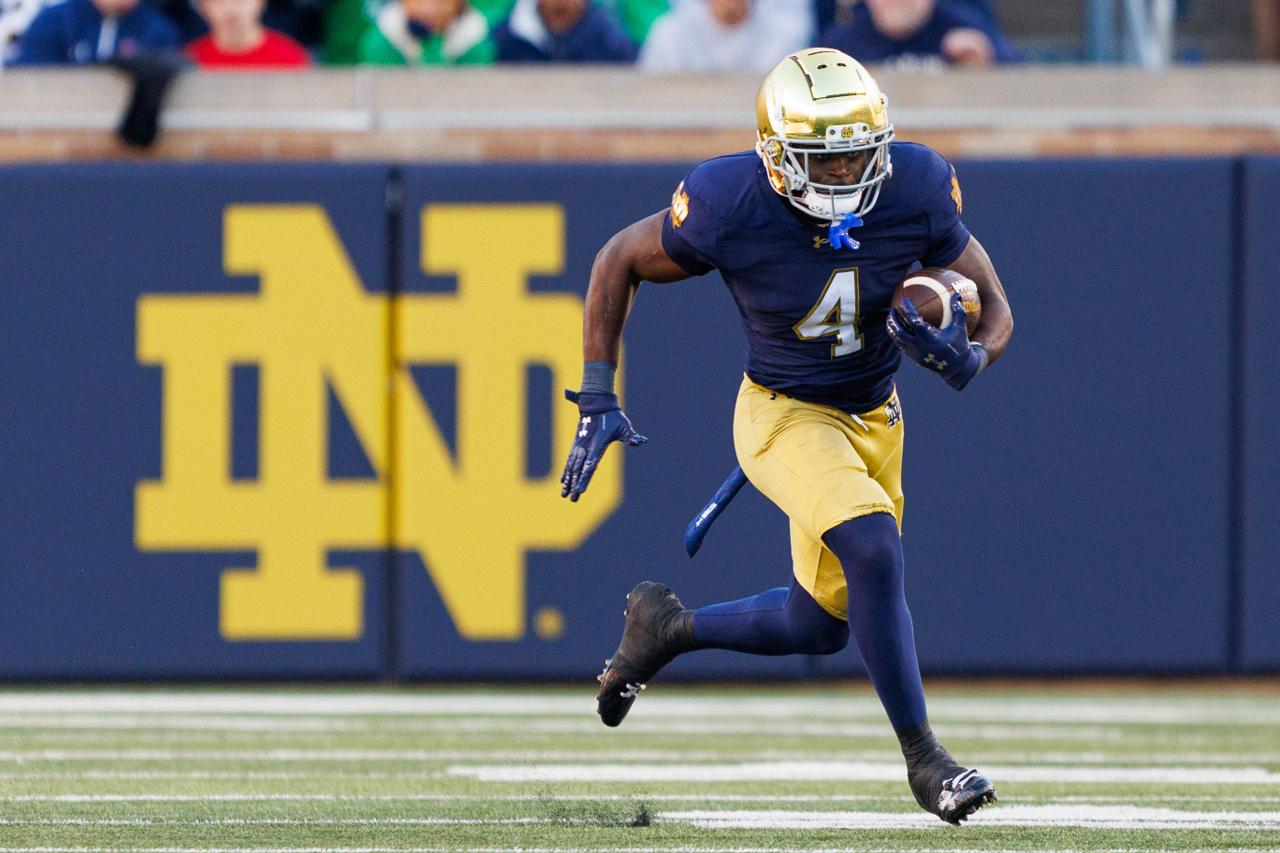
The NFL will always be about talent evaluation and acquisition, but that doesn't change the fixed constraints for general managers. Teams are constrained to a hard salary cap, and the NFL doesn't have a luxury tax like MLB, were wealthy owners can outspend poorer owners. That means every cap dollar spent has a very real opportunity cost in the zero-sum game of building a Super Bowl contender. Look no further than two-time Super Bowl GM John Schneider, who had to make big decisions on what to do with contracts for WR Jaxon Smith-Njigba, RB Kenneth Walker, WR Rashid Shaheed, and others this offseason (more on this later). Schneider and every other GM have one nerdy goal: maximize resource allocation (players) under a fixed constraint (cap and draft picks).
The NFL Rookie Wage Scale
Teams can acquire players via free agency signings, trades, or the NFL Draft. The first two are (mostly) free markets for players, while the draft has a fixed rookie wage scale. The draft slot — not position, not market value — determines what a rookie earns. The agreed-to salaries are meant to be a lot cheaper than what NFL veterans make on the open market, which means players on rookie contracts are the biggest market inefficiency. They are cheap! The teams who draft the best will always be the best teams in the NFL over the long haul, but "the best" in this sense isn't quite as straightforward as many draft analysts and draft fans make it seem. Unfortunately for ball purists, there are economics that absolutely factor into "the best".
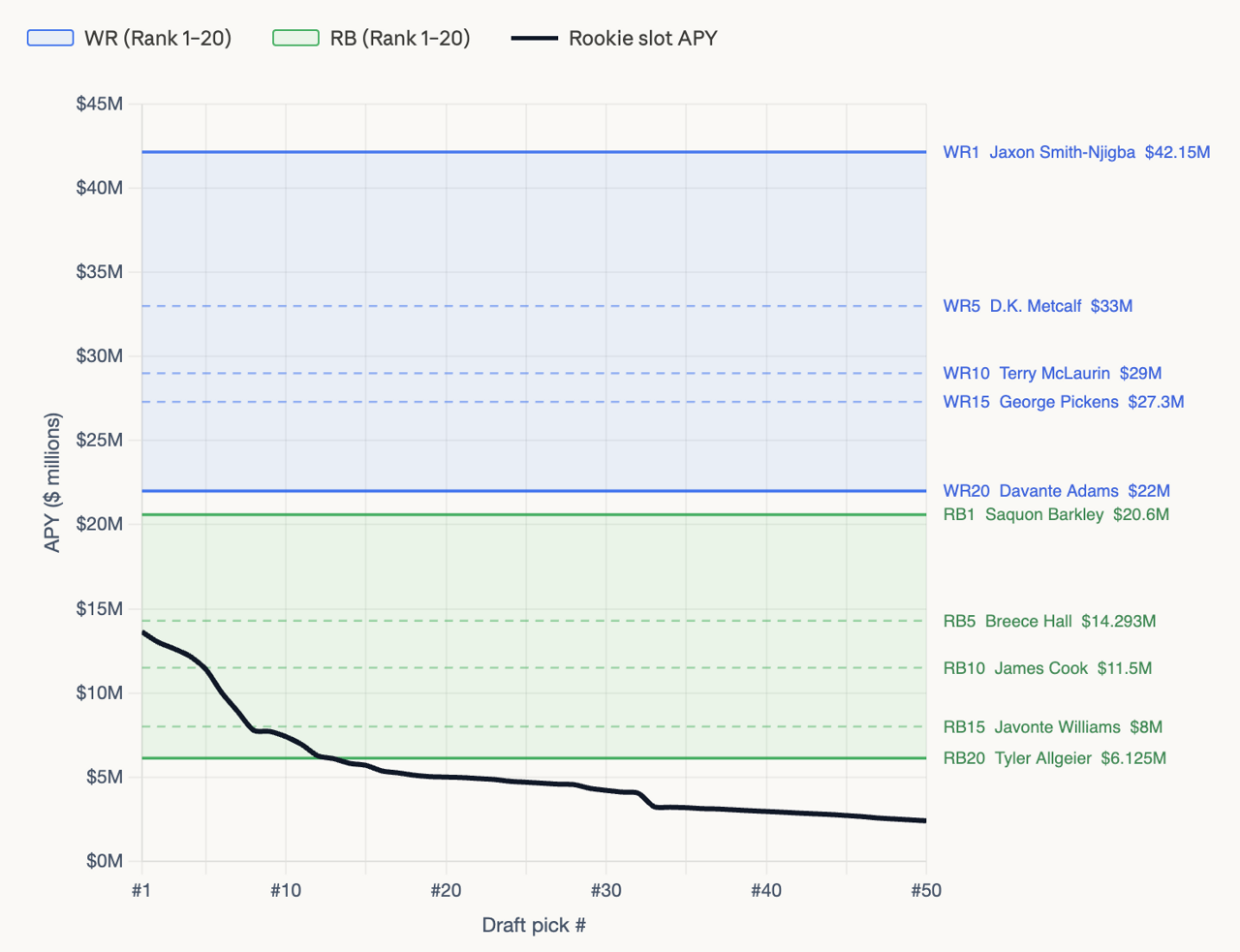
This chart compares the rookie per-year salaries of top-50 overall picks in the 2026 NFL Draft (black line) to the free market per-year salaries of the top-20 veterans at WR (blue) and RB (green). The entire goal of the NFL Draft is to find a bunch of WR Jaxon Smith-Njigbas ($42M/year) and to have them while they only make $2-14M per year. The $38M net savings of a JSN on last year's $4M rookie contract is what helped the Seahawks turn into Super Bowl champions. The same was true for RB Kenneth Walker's $14M free-market contract versus his $3M rookie-contract salary, another $11M in net savings!!!
Free Agency Setting Positional Values
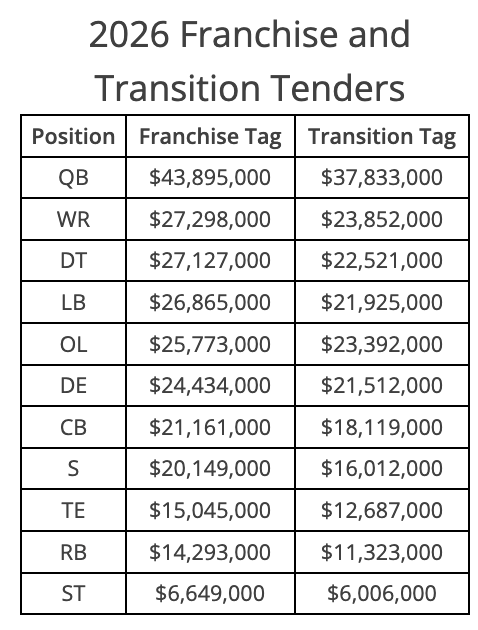
The chart also shows how each position is paid differently by the open market. It's very clear to say GMs (with millions at stake!!!) very-much believe the WR position as a whole is a lot more valuable than the RB position. The WR20 in salary makes more than the RB1 in salary right now. We can also look at the franchise tags across positions, which are set by the active top-5 salaries at each position, to see the general view of positional value on the open market:
Unfortunately, it's not just as simple as free market salaries between positions either. Another big factor in roster construction is how often veterans become available to sign, and there is a clear relationship between availability and positional value. Just think about a scenario where the Ravens let Lamar Jackson walk in free agency. It's unimaginable, but we don't blink an eye when C Tyler Linderbaum, TE Isaiah Likely, S Alohi Gilman, TE Charlie Kolar, or RB Keaton Mitchell leave. We've accepted that as fans. The same just happened with the Super Bowl Seahawks who opted to re-sign WR Rashid Shaheed, while letting RB Kenneth Walker and S Coby Bryant walk for roughly the same money. They absolutely did not do that for need reasons either, as they still don't have a quality RB on the roster while going 3-4 deep at WR in addition to their multiple TEs.
That means when a team has a need at C, TE, S, or RB in an offseason, there are plenty of available options in free agency or via trades with extremely little draft capital needed. When a team needs a WR in free agency, the best available options aren't franchise-tagged George Pickens or in-house extended Alec Pierce, they turn out to be Wan'Dale Robinson and Romeo Doubs. And when a team needs to find a WR via trade, it'll cost a 2nd-round-plus for D.J. Moore, who also got an at-market extension directly after the trade because of the contractual leverage that comes with being traded for. That part also very much matters. We can go back to my first chart and see that the teams paying for these top contracts at WR sometimes needed to send over a 2nd-round pick (DK Metcalf), a 3rd-plus-5th-round pick (George Pickens), or a conditional 3rd-rounder (Davante Adams) for the right to sign/tag them, while RBs Saquon Barkley, Javonte Williams, and Tyler Allgeier were just signed in free agency without the loss of a draft pick. The other two RBs, Breece Hall and James Cook, were just tagged/extended by their drafted teams, without the need to send over future draft picks upon signing.
Recent NFL Draft Examples
The Raiders weren't ready for a RB because their OL stunk, but this RB Ashton Jeanty pick will not age well even when he inevitably turns a corner with better talent around him. They took him 6th overall, which immediately made him the 8th-highest paid RB in the NFL at the time. If he turned out to be the 8th-best RB in the NFL right away, that'd still a terrible result, because the point of having draft picks is the net savings of the rookie wage scale versus the going-rate of NFL veterans, not to match their production at the same cost. Beyond that, Jeanty may not ever be the 8th-best RB in the NFL, even if he was a high-floor, universally-loved prospect. And the players drafted right after him were also great prospects and if they hit, the net savings are wildly higher. Those next picks were studs RT Armand Membou, WR Tetairoa McMillan, and LT Kelvin Banks. The 8th-highest paid RT makes $18M. The 8th-highest paid LT makes $22M. The 20th-highest paid WR makes $20M. Compare those numbers to the 8th-highest paid RB at $12M, not to mention the longevity differences of receivers and linemen versus backs.
The 2021 NFL Draft is instructive because nearly all of those players have now signed second contracts. The Atlanta Falcons drafted TE Kyle Pitts, one of the best prospects at that position ever, at 4th overall. He is playing on the $15M franchise tag without an extension. The players drafted after him were WR Ja'Marr Chase ($40M/year), WR Jaylen Waddle ($28M/year and, separately, the Dolphins were able to trade him away for a 1st-round pick), OT Penei Sewell ($28M/year), CB Jaycee Horn ($25M/year), CB Patrick Surtain ($24M/year), WR DeVonta Smith ($25M/year), QB Justin Fields ($30M guaranteed in 2025), EDGE Micah Parsons ($46.5M), and LT Rashawn Slater ($28.5M/year). A tight end has never signed for even $20M per year in NFL history, let alone this $24M low-end outcome.
What about the flip side when a team reaches for the less valuable position over a flawed prospect at a premium one? The 2022 NFL Draft was a perfect example with S Kyle Hamilton falling to 14th overall, despite his consensus top-10 ranking. Hamilton just signed a $25M per year contract and is widely considered one of the best safeties in football. The players who went right before him were WR Drake London (stud waiting for a contract in the $33M per year range), LT Charles Cross ($25M per year), WR Garrett Wilson ($32.5M per year), WR Chris Olave (stud waiting for a contract in the $33M per year range), WR Jameson Williams ($27M per year), and DT Jordan Davis ($26M per year). While it's awesome that the Ravens drafted Hamilton 14th, it's hard to say that he's that much more valuable than the guys drafted right before him. But it was a very good pick based on the players drafted right after him: OG Kenyon Green (less than my salary), WR Jahan Dotson ($7.5M per year), OG Zion Johnson ($16M per year), WR Treylon Burks ($2M per year), OT Trevor Penning ($3.5M). This is a perfect example of NFL GMs properly grading talent, comparing it to the going rate of these players on the open market, and then taking "the best" player available.
The takeaway isn't to always take a premium position. It's to always know what you're buying. A great player at a cheap position can absolutely be the right pick — but only if the net savings over a comparable veteran outweigh what you're giving up by passing on a premium position. Hamilton at 14 clears that bar. A running back at 6 almost never does.
So, what does this mean for the 2026 NFL Draft?
Positional value is especially important this year because many of the consensus top-10 prospects play at non-premium positions. LB Arvell Reese (2nd in consensus), RB Jeremiyah Love (4th), LB Sonny Styles (6th), S Caleb Downs (8th), and possibly even OG/Cs Francis Mauigoa (5th) and Spencer Fano (10th) depending on who you ask.
The first thing to do is to realistically compare them to veterans and see how valuable those players are on the open market. Is Jeremiyah Love somewhere between RB2 Christian McCaffrey ($19M) and RB5 Kenneth Walker ($14M)? Then he's worth about $17M or so, with the upside of being worth $22M or so if he can turn into Jamhyr Gibbs or Bijan Robinson. Is Sonny Styles between LB1 Fred Warner ($21M) and LB6 Devin Lloyd ($15M)? Then he's worth about $18M on the open market. And so on.
The key is then comparing them to the premium position prospects who may not be full blue-chip talents. I think EDGE David Bailey is a good example because he's lightning quick but smaller and not quite as bendy as the Von Miller types, so probably not a true blue-chip edge rusher. Is Bailey between EDGE14 Odafe Oweh ($24M) and EDGE18 Boye Mafe ($20M)? That seems fair, so he's worth $22M. We can always disagree on the likeliest player comparisons, but this example would indicate that a draft pick on Bailey offers more net savings than a draft pick on Love.
In other words, draft David Bailey and sign Kenneth Walker instead of drafting Jeremiyah Love and signing Harold Landry, at the same salary cap and draft pick allocation.
My goal when building out my Top 100 Big Board every year is to run this prospect-by-prospect calculation after watching their tape, modeling their profile, and comparing them to NFL veterans. That's the path to properly drafting "the best player available."